Мы используем cookie, чтобы обеспечить максимальное удобство использования нашего веб-сайта.
Contact Founder
Still have doubts?
Connect directly with our Founder. Whether it’s about pricing or technical details, get a straight answer and an exclusive “Founder’s Bonus” for your first order.
900+ Satisfied Clients
🏆 Over 1000+ Custom Projects Successfully Delivered.
Paper napkin foil stamping looks simple, but the real production window is narrow. In this EC-27 temperature test, 90°C, 100°C, 110°C, and 120°C created very different results on the same type of paper napkin.
The short answer: 110°C is the best production starting point. It gives a complete gold transfer, readable fine lines, clean circular edges, and much lower risk of paper deformation than 120°C.
This article is for paper napkin manufacturers, event packaging suppliers, wedding stationery brands, restaurant supply buyers, and small-batch studios that need a practical hot stamping baseline for thin paper napkins.
For background, paper is a fiber-based material, while hot stamping relies on heat, pressure, dwell time, and foil release behavior. See Paper и Hot stamping for general reference.
Better than 90°C, but still under the transfer threshold
110°C
Clean gold color, readable design, controlled paper surface
Best balance for production
120°C
Strong transfer, but paper wrinkling and edge stress appear
Good transfer, higher damage risk
For this material and design, 110°C is not simply “good enough.” It is the point where foil activation, paper compression, and image clarity reach the best balance.
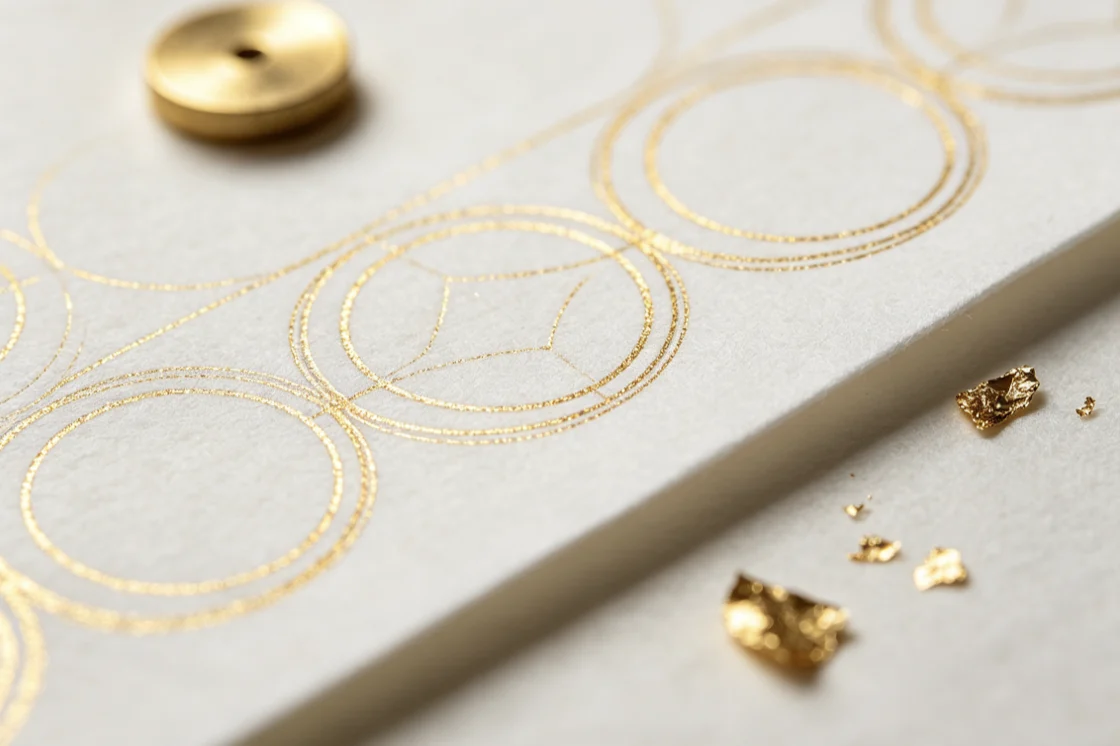
0.01 mm CNC‑engraved brass dies deliver crisp fine‑line foil transfer for custom branded paper napkin production.
Why Paper Napkins Are Difficult to Foil Stamp
Paper napkins are not like card stock, coated paper, or pearl paper envelopes. They are soft, porous, flexible, and often made with surface texture or embossing patterns.
This creates four technical challenges:
High absorbency: the surface can absorb heat and pressure unevenly.
Low thickness stability: the sheet compresses easily under the die.
Visible fiber movement: too much heat can wrinkle or distort the surrounding area.
Texture interference: the napkin pattern can break fine foil lines if transfer energy is not enough.
This is why paper napkin foil stamping needs a narrower process window than thicker paper. If the temperature is too low, the foil does not release. If the temperature is too high, the foil transfers, but the napkin surface may lose its clean appearance.
Test Setup: EC-27 Manual Hot Stamping Machine
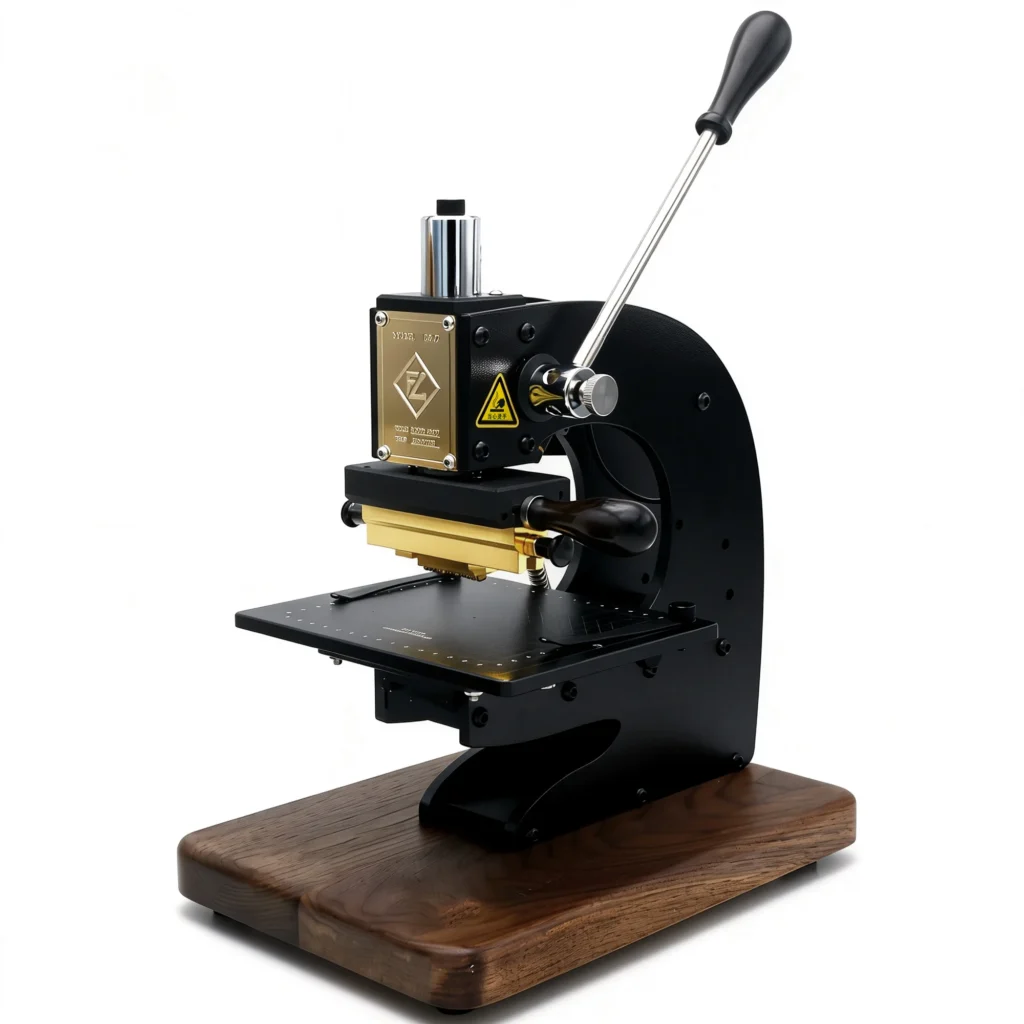
This test used the EC-27 Manual Hot Stamping Machine With Walnut Base. The same die, foil, pressure logic, and paper napkin material were used across the temperature test, so the comparison focuses mainly on temperature behavior.
The tested design includes a circular border, outer text, inner icon, and fine line details. This is a useful test pattern because it reveals both transfer strength and edge control:
the outer circle shows whether the die pressure is even,
the text shows whether fine lines can transfer,
the center icon shows whether solid curves remain clean,
and the surrounding paper shows whether the napkin is being overheated.
90°C Test Result: Too Cold for Reliable Foil Release
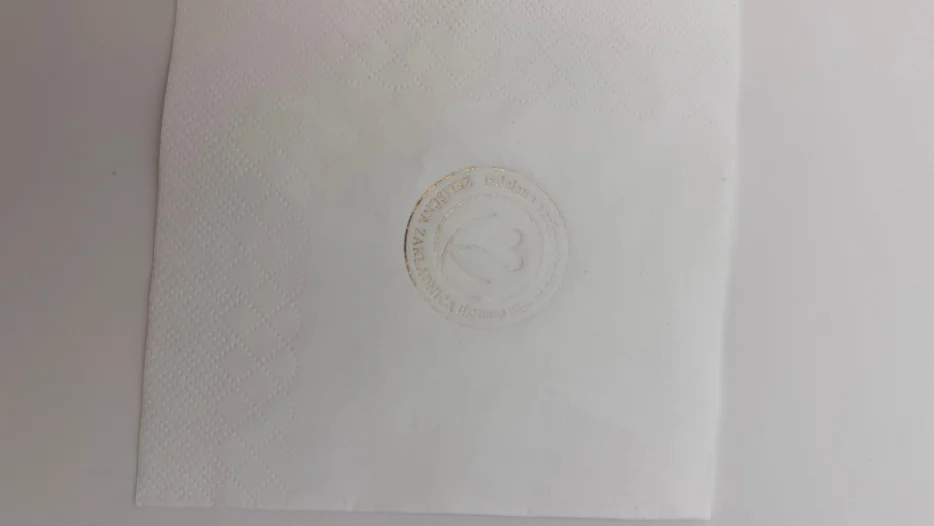
In the 90°C test image, the printed area is only faintly visible. The design can be seen mostly as a pressure impression or pale shadow, not as a strong gold foil transfer.
The outer circular text is hard to read, the center icon lacks metallic density, and the foil does not appear fully released from the carrier. This is a typical low-temperature failure mode.
Too‑low temperature creates only a faint pressure indent; foil adhesive cannot fully bond to porous napkin fibers.
What the image tells us
At 90°C, the foil adhesive layer is not reaching a stable activation point. The die still presses the design into the napkin, so a mark appears, but the metallic layer does not fully bond to the paper surface.
The result is not just “light color.” It is a process failure:
weak foil release,
poor metallic density,
incomplete line formation,
low visual contrast,
and unstable adhesion.
For production, this temperature would likely create inconsistent results from piece to piece. A slightly more textured napkin, a cooler room, or a shorter dwell time could make the defect even worse.
Should you fix 90°C by adding pressure?
Usually no. More pressure may deepen the indentation, but it will not fully solve foil release if the adhesive layer is still under-heated. On thin napkins, adding pressure can crush the paper before the foil transfers properly.
The correct adjustment is to raise temperature gradually, not to force the die harder.
100°C Test Result: Partial Activation, But Still a Ghost Image
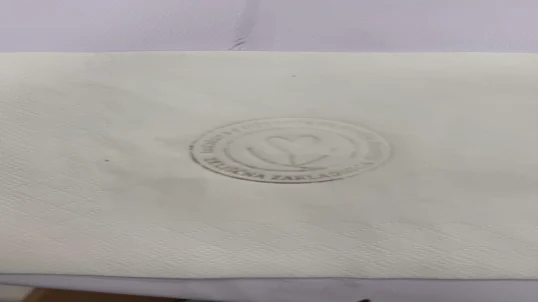
The 100°C test image shows an improvement over 90°C, but the result is still not production-ready. The design is more visible, yet the foil effect remains weak and grayish. It looks more like a ghost mark than a clean metallic stamp.
The circular shape is present, but the gold brightness is not strong enough. The fine text is blurred into the paper texture, and the visual contrast is too low for a decorative napkin product.
Near‑threshold temperature yields partial foil release; fine text and small graphic details will look faded in mass‑production.
What the image tells us
100°C is near the lower edge of the usable window, but it is still below the ideal transfer point for this foil-paper combination.
The foil may be starting to release, but not evenly. Some parts of the die contact the napkin well, while other fine-line areas fail to receive enough heat energy. This produces a half-transferred image: visible enough to prove alignment, but not clean enough to sell.
This result suggests three things:
The die is making contact.
The foil is beginning to activate.
The transfer energy is still insufficient for fine lines and small text.
Why the image looks gray instead of gold
A gray or dull mark often means the foil layer has not separated cleanly from its carrier film. The adhesive may soften slightly, but not enough to bond the metal layer evenly to the napkin fibers.
On a paper napkin, this is especially obvious because the white background provides high contrast. If the gold is weak, the image immediately looks dirty or faded.
For production, 100°C may be acceptable only for very simple, larger artwork. For logos with circular text, fine rings, and small details, it is still too low.
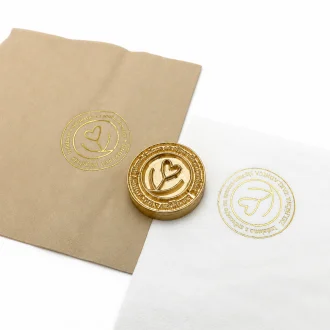
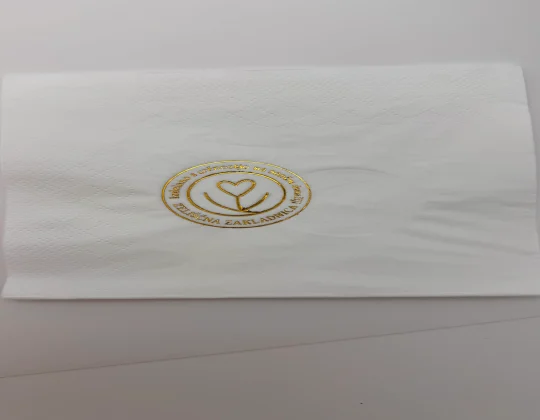
110°C Test Result: Best Balance of Transfer and Paper Safety
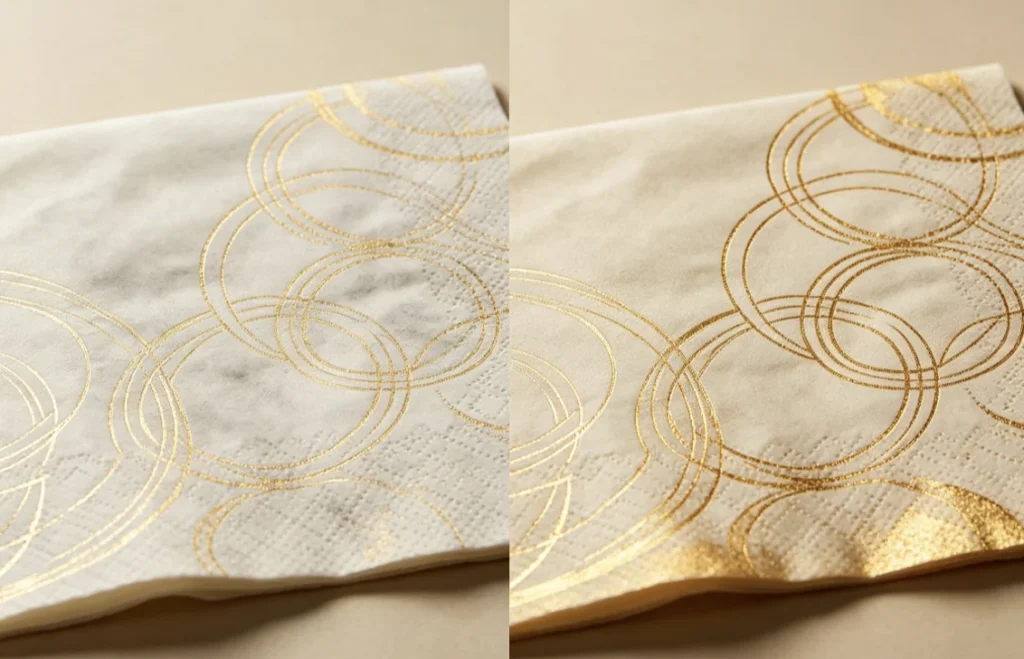
The 110°C test image shows the strongest overall result. The gold foil is bright, the circular border is clear, the central icon is readable, and the outer text has enough definition to identify the design.
The most important point is that the gold transfer looks complete without obvious overheating of the napkin. The paper remains flat enough, the stamped area does not show serious deformation, and the edges do not appear excessively thick.
110 °C is the balanced production baseline: full metallic foil transfer without wrinkling or paper‑fiber damage.
What the image tells us
At 110°C, the foil adhesive activates more completely and releases consistently from the carrier film. The die transfers enough heat into the foil to bond the metallic layer onto the paper fibers, but the napkin does not yet show major heat damage.
This is the best balance among the four test groups because it achieves:
full gold transfer,
clearer fine text,
stronger circular outline,
stable edge definition,
and acceptable surface protection.
The brown napkin and white napkin in the image also show an important production point: different paper colors change the visual contrast of the foil. Gold on brown looks warmer and softer; gold on white looks brighter and more obvious. But both results at 110°C are visually usable.
Why 110°C is the recommended baseline
110°C gives enough thermal energy to activate the foil while keeping the napkin surface under control. This is exactly what you want for thin paper products.
In production terms, 110°C provides a wider safety margin than 120°C. If the operator presses slightly longer, or if one batch of napkins is slightly thinner, 110°C is less likely to cause yellowing, wrinkling, or edge spread.
That is why 110°C should be treated as the first production reference, not merely as one successful sample.
120°C Test Result: Strong Transfer, But the Paper Is Under Stress
The 120°C test image shows a very clear gold result. The circular outline is strong, the center icon is well transferred, and the foil color looks dense. At first glance, this may look like the best result.
But the surrounding paper tells a different story. There are visible wrinkles and surface waves around the stamped area. The napkin appears to have been pulled or compressed by the combination of heat and pressure.
Hot stamping test @120°C on pearl paper napkin. Excessive temperature causes foil deformation, reference test for calibrating TJ8020PS hot stamping machine parameters. Zhengfei Mold factory‑direct custom brass stamping dies, 0.01mm CNC engraving precision.
What the image tells us
120°C provides enough heat for full foil transfer, but it also pushes the napkin close to its damage threshold. The paper fibers become more sensitive to pressure, and the stamped area begins to affect the surrounding surface.
This is a classic over-temperature risk on thin paper:
foil transfer looks strong,
edge lines may begin to gain thickness,
surface fibers compress more heavily,
nearby paper can wrinkle or wave,
and long-run consistency becomes harder to control.
The issue is not that 120°C cannot stamp. It clearly can. The issue is that it may stamp too aggressively for a soft napkin.
Why 120°C is risky for batch production
A single 120°C sample may look attractive because the gold is dense and bright. But in batch production, small variations matter.
If the napkin is slightly thinner, the pressure slightly higher, or the operator dwell time slightly longer, 120°C can quickly create:
yellowing,
deep compression marks,
edge spreading,
wrinkling,
paper hardening,
or local deformation.
For a display sample, 120°C may be useful when the design is bold and the napkin is strong. For stable production, it is safer to start at 110°C and adjust only if transfer is still incomplete.
Professional Diagnosis: What These Four Images Prove
The four temperature images show a clear process curve:
90°C is below the foil release threshold.
100°C enters partial activation but does not complete the transfer.
110°C reaches the best working window.
120°C crosses into a higher-risk zone where transfer improves but paper stability declines.
This is the key lesson: foil stamping quality is not only judged by how much gold appears. On thin paper napkins, the best result must be judged by four factors together:
foil density,
edge clarity,
fine-line readability,
and paper surface condition.
If you only judge foil brightness, 120°C can seem attractive. If you judge total production quality, 110°C is the stronger choice.
Recommended Production Parameters
Use this setting as the first trial point:
Высокоточное горячее тиснение кожи с EC-27, прямые закупки с завода на 30-50% дешевле.
The tested artwork has thin circular text, multiple ring lines, and a small center icon. This type of design is much harder than a simple bold logo.
For napkin foil stamping, fine details require a clean die and controlled pressure. If the die is too shallow, the foil may not transfer evenly. If the die is too sharp or pressure is too high, it can cut into the paper or make the edge look thick.
For custom artwork, use clean vector files and avoid details that are too small for the napkin texture. If you need custom tooling, see Индивидуальные латунные пресс-формы.
Paper Napkin vs Other Paper Materials
Paper napkins usually need gentler parameters than thicker paper products. If you are building a full paper-material process library, compare this test with:
These pages help explain why different paper surfaces require different heat windows.
Food-Service Note
If the napkin will be used around food or table service, confirm that the foil and related consumables meet the requirements of the sales region and final use scenario. For general reference, see the FDA overview of Food Contact Substances.
This point is especially important for restaurant napkins, event napkins, and branded packaging used near food. Decoration quality and material suitability should be checked together.
Internal Links You Can Use
This article fits well inside a paper and foil-stamping content cluster. Good internal links include:
What is the best temperature for paper napkin foil stamping?
Based on this EC-27 test, 110°C is the best starting temperature. It gives complete foil transfer while keeping the napkin surface more stable than 120°C.
Why did the 90°C test fail?
90°C was too low to activate the foil adhesive layer fully. The die created a faint pressure mark, but the metallic foil did not release and bond strongly enough to the napkin.
Why does the 100°C result look gray?
A gray ghost image usually means partial foil release. The foil adhesive begins to soften, but the gold layer does not transfer evenly across fine lines and text.
Why not choose 120°C if the foil looks stronger?
120°C gives stronger transfer, but the image shows paper wrinkling and surface stress. For batch production, this increases the risk of yellowing, deformation, and inconsistent results.
Can I use the same setting for all napkins?
No. Napkin thickness, fiber structure, surface texture, color, humidity, and foil type all affect the result. Use 110°C as a starting point, then test each material.
Conclusion
The four temperature images show that paper napkin foil stamping has a narrow but manageable working window. 90°C is too cold, 100°C is still weak, 110°C is the best balanced setting, and 120°C is strong but risky.
For production, start with 110°C on the EC-27, keep pressure moderate, and use short, consistent dwell time. Judge the result not only by foil brightness, but also by fine-line clarity and the condition of the surrounding napkin surface.
ZHENGFEI Technical Team shares practical hot stamping knowledge from real production tests, including brass die design, foil stamping parameters, machine setup, leather, paper, acrylic, plastic, wood and packaging applications.






 English
 Japanese
 Spanish
 French
 Korean
 German
 Russian